Showing posts with label nasa. Show all posts
Showing posts with label nasa. Show all posts
Friday, February 28, 2014
Video: Google`s SCHAFT robot wins DARPA Robotics Challenge.
Video: Google`s SCHAFT robot wins DARPA Robotics Challenge.
WorldWide Tech & Science. Francisco De Jesùs.
The "trials" for DARPA Robotics Challenge are over. After two days in which some of the most advanced robots in the world had to face difficult obstacles, the design that won first place was SCHAFT, developed by a team of the same name which is now under the wing of the Mountain View giant, Google.
Will have to wait until late 2014 for the final winner of the DARPA Robotics Challenge . The " trials" that determine the finalists were conducted between Friday and Saturday. Sixteen teams participated , all backed by institutions, agencies and companies of high prestige.
The tests, very focused on rescue and emergency scenarios led to limit the capabilities of all the robots , however , had the advantage of operating in " bound " , something that does not happen in the finals. In total , eight tests were : vehicle ( or is, lead ) , Property Ladder , Rubble , Door , Wall, Valve and Hose. None of the robots got a perfect score (32 points was the maximum ) , but one of them was very close : SCHAFT His name is owned by a Japanese team of the same name , and now responds to Google . If there was any doubt about the turn of Mountain View to robotics , this victory just dissipate it.
I think the only word to describe SCHAFT action is "impressive" but we must also remember that this kind of designs continue to evolve, therefore,we have not seen its roof. SCHAFT stayed in front at this stage of Robotics Challenge with 27 points, followed distantly by the IHMC Robotics team that scored 20 points on Atlas-Ian, Tartan and Rescue, the robot CHIMP scored 18 points. Tests proved far more complex than they appear.
In fact, there were three teams who failed to get any points, and to the surprise of many, one of those teams was the NASA robot that used his Valkyrie. The top eight teams will receive one million additional dollars to continue its development and prepare robots face the final. The jackpot? Two million dollars.
SAMSUNG SMART TV on Amazon store:


Monday, February 10, 2014
Space: NASA Video: Earth and the Moon moving through space together.
Space: NASA Video: Earth and the Moon moving through space together.
WorldWide Tech & Science. Francisco De Jesùs.
NASA Video:
When NASA's Juno spacecraft flew past Earth on Oct. 9, 2013, it received a boost in speed of more than 8,800 mph (about 7.3 kilometer per second), which set it on course for a July 4, 2016, rendezvous with Jupiter.
One of Juno's sensors, a special kind of camera optimized to track faint stars, also had a unique view of the Earth-moon system. The result was an intriguing, low-resolution glimpse of what our world would look like to a visitor from afar.
The cameras that took the images for the movie are located near the pointed tip of one of the spacecraft's three solar-array arms. They are part of Juno's Magnetic Field Investigation (MAG) and are normally used to determine the orientation of the magnetic sensors. These cameras look away from the sunlit side of the solar array, so as the spacecraft approached, the system's four cameras pointed toward Earth. Earth and the moon came into view when Juno was about 600,000 miles (966,000 kilometers) away -- about three times the Earth-moon separation.
During the flyby, timing was everything. Juno was traveling about twice as fast as a typical satellite, and the spacecraft itself was spinning at 2 rpm. To assemble a movie that wouldn't make viewers dizzy, the star tracker had to capture a frame each time the camera was facing Earth at exactly the right instant. The frames were sent to Earth, where they were processed into video format.
The music accompaniment is an original score by Vangelis.

Thursday, January 2, 2014
Scientists predict that new Pakistani island will sink back in a year.
WorldWide Tech & Science. Francisco De Jesùs.
NASA pictures.


People use boats as they visit an island that rose from the sea following an earthquake, off Pakistan's Gwadar coastline in the Arabian Sea September 25, 2013.

Scientists predict that new Pakistani island will sink back in a year.
“The island is really just a big pile of mud from the seafloor that got pushed up. This area of the world seems to see so many of these features because the geology is correct for their formation. You need a shallow, buried layer of pressurized gas—methane, carbon dioxide, or something else—and fluids. When that layer becomes disturbed by seismic waves (like an earthquake), the gases and fluids become buoyant and rush to the surface, bringing the rock and mud with them,” Bill Barnhart, a geologist at the US Geological Survey told NASA’s Earth Observatory.
The Earth Observatory says this is not the first island to have surfaced along the 700-kilometer-long coast over the past century. Scientists predict that the new island will remain above surface for up to a year before sinking back into the Arabian sea.
The island rose out of the water during a 7.7-magnitude earthquake that struck Balochistan, just 69 km north-northeast of Awaran - the nearest Pakistani city - on 24 September 2013. Over 300,000 people were affected by the quake, which caused over 500 deaths, and some 21,000 houses were destroyed.
Monday, November 18, 2013
NASA: MAVEN launches on 10 months journey to Mars orbit.Video.


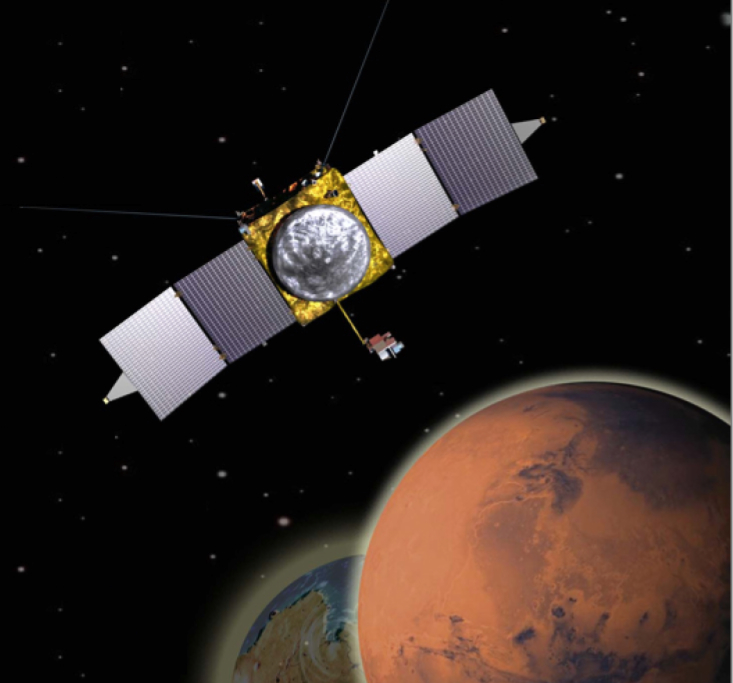
At 1:28 p.m. EST, NASA's Mars Atmosphere and Volatile EvolutioN (MAVEN) spacecraft launched aboard a United Launch Alliance Atlas V rocket from Cape Canaveral Air Force Station in Florida, beginning a 10-month journey to Mars orbit. MAVEN will take critical measurements of the Martian upper atmosphere to help scientists understand climate change over the Red Planet's history.
Buy the Samsug Galaxy Note 10.1 2014 edition:

Subscribe to:
Comments (Atom)